Onthisveryspot Global Travel: What the Site Is, How to Use It, and Where It Falls Short

If you search for onthisveryspot global travel, you will find a pile of pages that describe the same website in four different ways. One calls it a memory map. Another calls it a directory of cafes and murals. A third calls it a coordinate-based story archive, and a fourth treats it as a history-of-landmarks tool. Most of these pages are near-copies of each other, and few show a screenshot, a sample pin, or a named author.
This guide is written for US travelers who want a straight answer. It explains what the published sources agree on, where they contradict each other, how to test the site yourself in ten minutes, and how to build a trip around a location-based story layer without depending on any single website. designmode24, lcfmodgeeks
What Is OnThisVerySpot? The Short Version
OnThisVerySpot (onthisveryspot.com) is a location-based website built around the idea that a place has stories attached to it. You open a map, zoom to a city or street, and read short notes, photos, or historical details pinned to specific spots. onthisveryspot .com contact email
That much is consistent across the sources. The disagreement starts with what kind of content those pins hold.
The Four Descriptions in Circulation
| Description | What it claims | Who is describing it |
|---|---|---|
| Local memory map | Personal stories and everyday moments pinned to places | The site’s own guide pages |
| Hidden-gem directory | Cafes, murals, viewpoints, small shops with photos and short reviews | The site’s “spots” guide pages |
| Story archive | Short entries tied to exact coordinates, with author and visit date | The site’s own history-focused guide |
| Landmark history tool | Historical events linked to places worldwide | Third-party travel blogs |
These are not necessarily incompatible. A platform can hold personal memories, local recommendations, and history at the same time. But no page explains how these content types are separated, labeled, or verified, and that is the first thing a careful traveler should want to know.
What Nobody Explains Clearly
- Who operates the site and when it launched
- How many pins exist, and where they are concentrated
- Whether pins are reviewed before publication, and by whom
- Whether an app exists or the site is web only
- Which features are free and which are paid
Some third-party posts say the core features are free while premium content may need a subscription. The site’s own pages do not lay out a pricing structure. Until that is clarified, treat any claim about premium tiers as unconfirmed.
Onthisveryspot Global Travel: What “Global” Actually Means
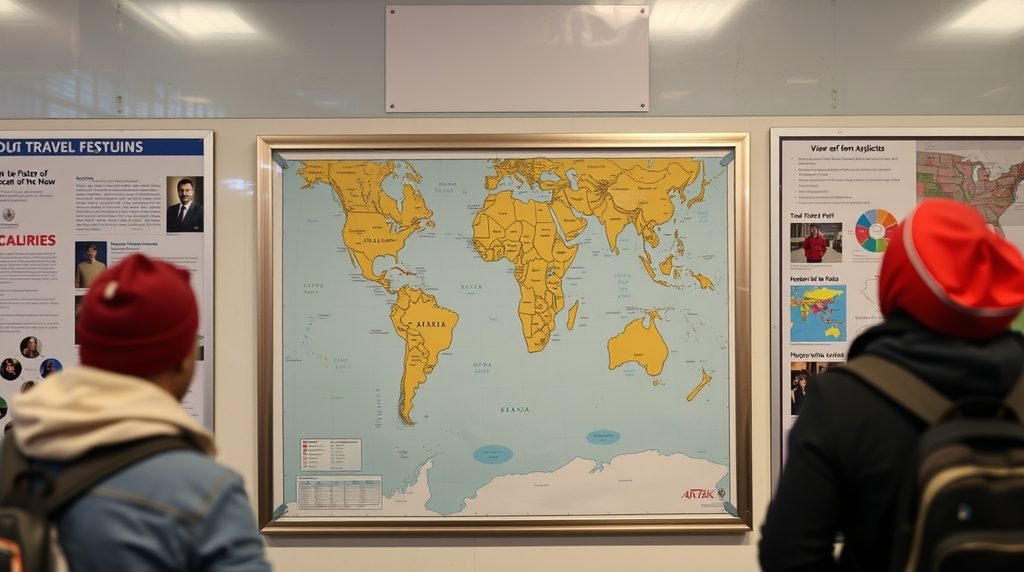
The word “global” appears in nearly every article on the topic. It is worth slowing down here, because a map that can technically show any country is not the same as a map with useful content in every country.
One third-party post claims the platform is expanding into Africa and Latin America, supports 45 languages through AI translation, and passed 10,000 submissions in a single year. It provides no source, no methodology, and no link to a data page. Numbers like these should be treated as marketing claims until you see them confirmed on the site itself.
How Coverage Usually Works on User-Contributed Maps
Community-built maps tend to be dense in a few places and thin everywhere else. Big tourist cities, university towns, and areas with active volunteers get many pins. Rural regions and countries with fewer contributors get very few. So onthisveryspot global travel is best understood as “global in reach, uneven in depth.”
Before you plan a trip around it, check the pin density for your specific destination. Here is a quick test:
- Search the exact neighborhood you will visit, not just the city.
- Count how many entries appear within a walkable radius.
- Check whether entries have dates, authors, and photos.
- Look for entries that cite a source rather than just a memory.
If a neighborhood shows fewer than five entries, plan to use another source for that stop.
Onthisveryspot Global Travel for US Travelers
American travelers have a different problem than international visitors. In the US, history and local culture are spread across thousands of small places: a roadside marker in Georgia, a former mill town in Massachusetts, a mural in a Los Angeles alley, a civil rights site in Alabama. A story map can be useful for exactly this kind of scattered, low-profile content, because large guidebooks skip most of it.
Where a Story Map Helps Most in the US
- Road trips: stopping at small historical or cultural sites between big destinations
- City walking routes: adding context to a neighborhood you would otherwise just pass through
- Family trips: giving kids a “what happened here” story at each stop
- Homeschool and classroom projects: assigning students a local spot to research and document
Where It Is Weaker
- Time-sensitive info: hours, closures, and prices change, and user-contributed pins go stale
- Safety and accessibility details: these need official sources
- Fact-checked history: a personal memory is not a historical record
For factual history in the US, pair it with established sources such as the Historical Marker Database (HMDB), state historic preservation offices, and the National Park Service. Treat the story map as a way to discover a spot, and the official source as the way to confirm what happened there.
How to Test the Site Yourself in Ten Minutes
Since the published guides offer no verifiable walkthrough, do your own. This checklist takes about ten minutes and tells you whether the site is worth adding to your trip planning.
Step-by-Step Test
- Open onthisveryspot.com on your phone and on a laptop. Note whether the map loads quickly on both.
- Zoom to a place you know well, such as your hometown or a city you have lived in.
- Read five entries. Do you recognize the details as accurate?
- Check whether entries show an author, a date, and a source link.
- Search for a destination you plan to visit in the next six months.
- Try to save or share a spot, and note whether it requires an account.
- Look for a clear privacy policy and contact page.
How to Score What You Find
| Check | Good sign | Warning sign |
|---|---|---|
| Accuracy on a place you know | Details match what you know | Errors or vague filler |
| Author and date on entries | Shown on most entries | Missing or inconsistent |
| Source links | Present on history entries | None anywhere |
| Content density | Many entries in your area | A handful of pins |
| Privacy and contact info | Easy to find | Hard to locate |
If a page scores poorly on accuracy and sourcing, use it for inspiration only.

A Practical Onthisveryspot Global Travel Workflow
Here is how to fit a story map into a real trip without letting it run the plan. This works whether you use this site or another one.
Step 1: Build the Skeleton First
Book flights, lodging, and the main attractions using your usual tools. A story map is a layer on top of a plan, not the plan itself.
Step 2: Add a Story Layer
For each day, pick two or three stops from the map that sit within a short walk or drive of your main plans. Save them to a note or a map list you control, since you cannot rely on any single site staying online or unchanged.
Step 3: Verify Before You Go
For every stop you add, confirm three things using another source:
- The place still exists and is open to visitors
- The story matches an independent record
- Getting there is safe and accessible for your group
Step 4: Leave Room for Skipping
Some pins will disappoint. A memorial may be a small plaque. A cafe may be closed. Build slack into the day so a dead end costs you ten minutes, not an afternoon.
Sample Day: A Historic Downtown Walk
This is a template, not a report from the site.
| Time | Stop type | Purpose |
|---|---|---|
| 9:00 AM | Main attraction | Anchor of the day |
| 11:00 AM | Story-map stop | A mural or plaque near the anchor |
| 12:30 PM | Local lunch | A cafe recommended by residents |
| 2:00 PM | Historical marker | Verified against an official source |
| 4:00 PM | Free time | Buffer for changes and rest |
Onthisveryspot Global Travel Compared With Alternatives
No single tool covers everything. Here is how the main options differ in purpose.
| Tool | Best for | Main limitation |
|---|---|---|
| OnThisVerySpot | Place-attached stories and local spots | Unclear sourcing and coverage |
| Atlas Obscura | Unusual and offbeat places, editor-reviewed | Fewer everyday or personal stories |
| Historical Marker Database | Verified historical markers, mostly US | Limited to marked sites |
| HistoryPin | Historic photos matched to locations | Content depends on partner archives |
| Google Maps | Hours, reviews, navigation | Little historical depth |
| Roadtrippers | Route planning with stops | Less focus on stories |
The strongest approach for most travelers combines two: one for discovery and one for verification. If you like the idea of onthisveryspot global travel, use it for discovery and let HMDB, Google Maps, or an official tourism site handle the confirmation.
Pros and Cons
What Works
- The idea is strong: stories tied to exact places make walking around more interesting
- Simple map-first design is easy to grasp
- Community contribution can surface places guidebooks miss
- Useful for teachers and families who want local context
What Does Not
- Contradictory descriptions across sources make the site hard to evaluate
- Statistics in circulation are unsourced
- Near-duplicate pages under misspelled URLs suggest low editorial care
- Unclear moderation makes accuracy uncertain
- Pricing and premium features are not clearly documented
Safety and Privacy Basics
Any site that pins content to exact locations raises a few practical concerns.
- Do not post your live location. Share stories after you leave, not while you are still there.
- Be careful with home addresses. Do not pin your own house or a private residence.
- Check the account requirements. If a site asks for personal data before showing basic content, ask why.
- Confirm before you rely on it. Do not use a user-contributed pin as your only guide to a remote or unfamiliar area.
Who Should Use It, and Who Should Skip It
Good Fit
- Travelers who enjoy wandering and reading about small, overlooked places
- Teachers building local history assignments
- Families looking for simple story-based stops on road trips
- Writers and photographers hunting for context
Not a Good Fit
- Anyone who needs verified, citable history
- Travelers on a tight schedule with no room for detours
- People who need up-to-date hours, prices, or accessibility details
Bottom Line
Onthisveryspot global travel is an appealing idea backed by muddy public information. The concept of pinning stories to real places works, and it suits the way many Americans actually travel, through small towns, side streets, and stops that never make a top ten list. But the sources describing it disagree on basic facts, and the impressive numbers floating around lack any visible source.
Use the site as a starting point, run the ten-minute test, and verify anything that matters against an official or independent record. That approach gets you the best of the concept without the risk of trusting a claim nobody can confirm.
Frequently Asked Questions
Is OnThisVerySpot free to use?
Some third-party sources say core features are free with possible premium content, but the site does not clearly document its pricing. Check the site directly.
Is OnThisVerySpot a travel booking site?
No source describes it as a booking platform. It is described as a map of places and stories, not a place to buy flights or hotels.
Does OnThisVerySpot cover the whole world?
It can show places worldwide, but content is likely to be denser in popular areas. Check the pin count for your specific destination.
Can I trust the history on OnThisVerySpot?
Treat entries as leads, not facts. Confirm important details with a marker database, museum, or official tourism source.
Is there an OnThisVerySpot app?
The sources do not confirm one. Third-party posts say the site works on mobile browsers.
What is a good alternative for finding hidden places?
Atlas Obscura, HistoryPin, and the Historical Marker Database each cover part of the same ground.
Can I add my own story or place?
Sources say users can contribute, but the exact process and review rules are not clearly explained.
How should I use it on a US road trip?
Save two or three story stops per day near your main plans, verify each one elsewhere, and leave buffer time.
[…] The problem with most existing coverage of onthisveryspot video gaming is that it stops at describing the concept and never shows you the mechanics. So let’s actually walk through it. onthisveryspot global travel […]