How to Do Implicit Differentiation: A Step-by-Step Guide (With 6 Worked Examples)
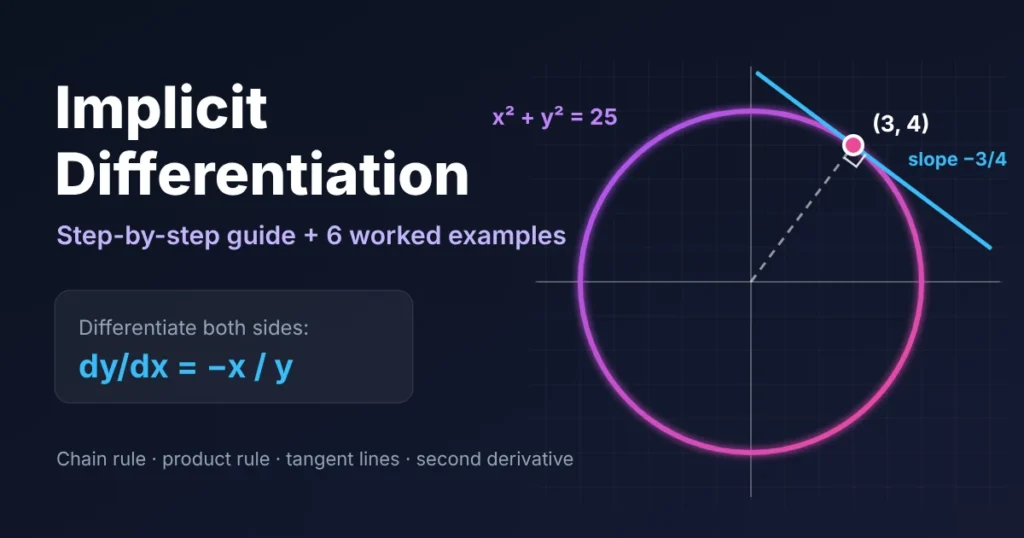
Most students meet implicit differentiation the same way: a homework problem gives an equation like x² + y² = 25 and asks for dy/dx, and there is no “y =” anywhere to start from. The usual derivative rules suddenly feel useless. They are not. Implicit differentiation is the same calculus you already know, applied with one extra habit: every time you differentiate a term that contains y, you multiply by dy/dx.
This guide explains that habit from the ground up. You will learn what an implicit function is, why the chain rule makes the whole method work, and a four-step routine you can apply to any equation. Then we work through six examples of increasing difficulty, from a simple circle to a second derivative, and finish with the mistakes that cost students the most marks on exams.
By the end you should be able to look at any equation in x and y, find the slope of its curve at any point, and check your own answer with confidence.
What Is Implicit Differentiation?
Implicit differentiation is a technique for finding the derivative dy/dx when y is not written explicitly as a function of x. It lets you find the slope of a curve straight from its equation, without first solving for y.
Explicit vs implicit functions
An explicit function gives y directly in terms of x. Examples are y = x³ − 4x, y = sin(x) or y = e^(2x). To differentiate them you apply the power rule, product rule, quotient rule or chain rule, and you are done.
An implicit function hides the relationship inside an equation that mixes x and y. Examples are:
- x² + y² = 25 (a circle of radius 5)
- xy = 6 (a hyperbola)
- x³ + y³ = 6xy (the folium of Descartes)
- sin(xy) = x
Some of these can be solved for y, but the result is messy or splits into several pieces. The circle, for example, becomes y = √(25 − x²) on the top half and y = −√(25 − x²) on the bottom half. Others, like the folium of Descartes, cannot be solved for y in any simple way at all. Implicit differentiation skips that algebra completely.
Why it is allowed
Even when you cannot write y as a formula, the equation still defines y as a function of x near most points of the curve. This idea is made precise by the implicit function theorem, a result from multivariable calculus. For everyday problems you only need its practical meaning: near a point where the curve is smooth and not vertical, y behaves like a differentiable function of x, so dy/dx exists and can be found.
The notation dy/dx comes from Gottfried Wilhelm Leibniz, one of the two founders of calculus. It is especially helpful here, because it reminds you that y depends on x. You will also see the derivative written as y′ (“y prime”); both mean the same thing.
The Chain Rule Is the Secret
The whole method rests on the chain rule. When you differentiate a function of another function, you multiply by the derivative of the inside. In implicit differentiation, y itself is the “inside”: it is a hidden function of x.
So when you differentiate y² with respect to x, you do not get 2y. You get 2y · dy/dx. The 2y is the outer derivative, and dy/dx is the derivative of the inside. The same idea applies to every term that contains y:
| Term | Derivative with respect to x |
| y | dy/dx |
| y² | 2y · dy/dx |
| y³ | 3y² · dy/dx |
| sin(y) | cos(y) · dy/dx |
| e^y | e^y · dy/dx |
| ln(y) | (1/y) · dy/dx |
Terms that contain only x are differentiated normally, with no extra factor. Terms that contain both x and y, such as xy or x²y³, need the product rule as well as the chain rule.
How to Do Implicit Differentiation in 4 Steps
This routine works for every implicit differentiation problem you will meet in a first calculus course:
- Differentiate both sides of the equation with respect to x. Treat x normally. Treat y as a function of x, so every y-term gets a dy/dx factor from the chain rule.
- Collect every term containing dy/dx on one side of the equation and move everything else to the other side.
- Factor out dy/dx.
- Divide to isolate dy/dx. If the question gives a point, substitute its x and y values to get a number: the slope of the tangent line at that point.
The answer will usually contain both x and y. That is normal and correct. The slope of a curve like a circle depends on where you are on it, and two points can share the same x-value.
Implicit Differentiation Examples, Step by Step
Example 1: The slope of a circle
Find dy/dx for x² + y² = 25, and the slope of the tangent line at (3, 4).
Differentiate both sides with respect to x. The derivative of x² is 2x. The derivative of y² is 2y · dy/dx. The derivative of the constant 25 is 0:
2x + 2y · dy/dx = 0
Move 2x to the right side and divide by 2y:
dy/dx = −x / y
At the point (3, 4), the slope is −3/4. The tangent line through that point is y − 4 = −(3/4)(x − 3), which simplifies to y = −(3/4)x + 25/4.
Notice something neat: the radius from the center (0, 0) to (3, 4) has slope 4/3. Multiply 4/3 by −3/4 and you get −1, so the tangent line is perpendicular to the radius, exactly as geometry predicts.
Example 2: A product of x and y
Find dy/dx for xy = 6.
The left side is a product, so use the product rule: the derivative of x times y, plus x times the derivative of y:
1 · y + x · dy/dx = 0
Solve for dy/dx:
dy/dx = −y / x
The slope is always negative where x and y have the same sign, which matches the shape of the hyperbola y = 6/x: it falls from left to right on both branches. You can confirm the result by writing y = 6/x and differentiating explicitly: dy/dx = −6/x². Since y = 6/x, −y/x equals −6/x². Both methods agree.
Example 3: The folium of Descartes
Find dy/dx for x³ + y³ = 6xy, and the slope at (3, 3).
This famous curve, named after the mathematician René Descartes, cannot be solved neatly for y, so implicit differentiation is the natural tool. First check that (3, 3) is on the curve: 27 + 27 = 54 and 6 · 3 · 3 = 54. It is.
Differentiate both sides. The right side 6xy needs the product rule:
3x² + 3y² · dy/dx = 6y + 6x · dy/dx
Collect the dy/dx terms on the left:
3y² · dy/dx − 6x · dy/dx = 6y − 3x²
Factor and divide (and cancel the common factor 3):
dy/dx = (2y − x²) / (y² − 2x)
At (3, 3): dy/dx = (6 − 9) / (9 − 6) = −1. The tangent line at that point slopes downward at 45 degrees.
Example 4: A trigonometric equation
Find dy/dx for sin(xy) = x.
The outer function is sine and the inside is xy, so the chain rule gives cos(xy) times the derivative of xy. That inner derivative needs the product rule:
cos(xy) · (y + x · dy/dx) = 1
Divide both sides by cos(xy), then isolate the dy/dx term:
y + x · dy/dx = 1 / cos(xy)
dy/dx = (1 − y · cos(xy)) / (x · cos(xy))
This is where most students slip: they apply the chain rule to sine but forget that the inside, xy, also needs the product rule. Write the inner derivative in brackets first, as above, and you will not miss it.
Example 5: An exponential equation
Find dy/dx for e^y = x² + y.
The derivative of e^y is e^y · dy/dx. On the right side, x² gives 2x and y gives dy/dx:
e^y · dy/dx = 2x + dy/dx
Move the dy/dx terms together and factor:
dy/dx · (e^y − 1) = 2x
dy/dx = 2x / (e^y − 1)
This example shows why step 2 matters. The term dy/dx appears on both sides, so you must collect it before you can solve.
Example 6: The second derivative of a circle
Find d²y/dx² for x² + y² = 25.
From Example 1 we know dy/dx = −x/y. Differentiate this again with the quotient rule, remembering that y still depends on x:
d²y/dx² = −(y − x · dy/dx) / y²
Now substitute dy/dx = −x/y:
d²y/dx² = −(y + x²/y) / y² = −(x² + y²) / y³
The original equation says x² + y² = 25, so the answer simplifies beautifully:
d²y/dx² = −25 / y³
On the top half of the circle (y > 0), the second derivative is negative, so the curve is concave down. On the bottom half (y < 0), it is positive, so the curve is concave up. That matches the picture of a circle exactly. Using the original equation to simplify, as we did here, is a classic exam technique.
6 Common Implicit Differentiation Mistakes
Teachers see the same errors on every exam. Avoid these and you avoid most lost marks:
- Forgetting dy/dx on a y-term. Writing the derivative of y² as 2y instead of 2y · dy/dx is the single most common error. Every y-term needs it.
- Adding dy/dx to x-terms. The derivative of x² is just 2x. Only terms containing y get the extra factor.
- Skipping the product rule. Terms like xy, x²y or xy³ contain two functions of x multiplied together, so they always need the product rule.
- Forgetting that a constant’s derivative is zero. In x² + y² = 25, the 25 becomes 0, not 25.
- Not collecting all dy/dx terms. If dy/dx appears on both sides, as in Example 5, move every copy to the same side before factoring.
- Substituting a point that is not on the curve. Before plugging in a point, check that it satisfies the original equation, as we did with (3, 3) in Example 3.
Where Implicit Differentiation Is Used
Implicit differentiation is not only an exam topic. It is the engine behind several ideas you will use later in mathematics, science and economics.
Related rates
Related rates problems ask how fast one quantity changes when another one does. The classic example is a ladder sliding down a wall. A 10-foot ladder leans against a wall, so x² + y² = 100, where x is the distance of the foot from the wall and y is the height of the top. Differentiate with respect to time t:
2x · dx/dt + 2y · dy/dt = 0
If the foot slides away at 2 feet per second when it is 6 feet from the wall, then y = 8, and dy/dt = −(6 · 2) / 8 = −1.5 feet per second. The top of the ladder is falling at 1.5 feet per second. That is implicit differentiation, with time instead of x.
Economics
In microeconomics, an indifference curve shows every combination of two goods that gives a consumer the same satisfaction, for example xy = 100. Its slope, found implicitly, is −y/x. The marginal rate of substitution is the size of that slope, y/x: how many units of one good a consumer will give up for one more unit of the other.
Physics and engineering
Planetary orbits are ellipses, x²/a² + y²/b² = 1. Implicit differentiation gives the direction of motion at any point on the orbit. Engineers use the same technique on curves defined by design constraints, where solving for y would be impractical.
How to Check Your Answers
Implicit differentiation has many small steps, and one dropped sign changes the whole answer. Three quick checks catch most errors:
- Test a point. Pick a point on the curve, compute the slope from your formula, and see if it makes sense on a sketch of the graph. A positive slope should rise, a negative one should fall.
- Solve explicitly when you can. For simple equations like xy = 6, solve for y, differentiate normally and compare, as we did in Example 2.
- Use a step-by-step calculator. A free derivative calculator with steps shows each rule it applies, so you can compare its working line by line with yours and find exactly where you went wrong. It is also useful for checking the ordinary derivatives inside a problem, such as the derivative of sin(xy) or e^(2x).
Use the calculator to check, not to replace, your own work. Exams test the method, and the method is what lets you solve problems no calculator was set up for.
Studying Calculus in Spanish?
Many students learn calculus in Spanish at school or university, in Latin America, Spain or as bilingual learners elsewhere, and exams use the Spanish terms: derivada implícita, regla de la cadena, recta tangente. If that is you, this guide on derivadas implícitas paso a paso covers the same method in Spanish, with five worked examples, including circles, xy = c and sen(xy). Reading the method in the language of your exam makes the vocabulary stick, and the mathematics is identical in both languages.
Frequently Asked Questions
When should I use implicit differentiation?
Use it when y is not given as a formula in x, or when solving for y would be messy or impossible. Equations that mix x and y, like x² + y² = 25 or x³ + y³ = 6xy, are the typical cases.
Why do I multiply by dy/dx?
Because y is a function of x, and the chain rule says the derivative of a function of y is its derivative with respect to y times dy/dx. Multiplying by dy/dx is the chain rule in action.
Can the answer contain both x and y?
Yes. That is normal for implicit derivatives. To get a number, substitute the coordinates of a point on the curve.
Is implicit differentiation the same as partial differentiation?
No. Partial differentiation treats the other variables as constants. Implicit differentiation treats y as a function of x. The two are connected, though: for an equation F(x, y) = 0, the slope is dy/dx = −(∂F/∂x) / (∂F/∂y), a shortcut you will meet in multivariable calculus.
How do I find the second derivative implicitly?
Differentiate dy/dx again with respect to x, treating y as a function of x, then substitute your expression for dy/dx. Use the original equation to simplify where you can, as in Example 6.
Where does the tangent line become vertical?
Where the denominator of dy/dx is zero but the numerator is not. On the circle x² + y² = 25, dy/dx = −x/y, so the tangent is vertical where y = 0: at the points (5, 0) and (−5, 0).
Conclusion
Implicit differentiation looks intimidating only until you see the pattern. Differentiate both sides, attach dy/dx to every y-term, collect, factor and solve. The six examples above, from the circle to the second derivative, cover every type of problem you are likely to meet in a first calculus course. Practise each one without looking, check your answers with a step-by-step calculator, and the method will soon feel as natural as the power rule.